Hiển thị các bài đăng có nhãn Favorite plant descriptions. Hiển thị tất cả bài đăng

Thứ Hai, 12 tháng 11, 2012

A few of my garden favorites (and some I wish I'd never planted)... post #4


Syringa x chinensis 'Lilac Sunday'
Abundant blooms which in addition to branch tips, occur from 
lateral buds quite far down the stems, creating a mass of bloom.
Arching habit to twelve feet high, ten feet wide.
Very fragrant.
Flower buds may be susceptible to spring frost damage but zone 4 hardy or colder.
The mass of bloom makes up for the small floret size.
Named for the Lilac Sunday Festival at Arnold Arboretum which houses
 one of the oldest and largest lilac collections in the United States
In a word... spectacular...
(YES)


*****


William Baffin Rose
From the Explorer series out of Canada
Yes, this is very hardy and as such could be a blessing to 
folks living in zones as far north as 3 or colder
Seven to ten feet in height.
Not a blessing for me... here's why...
Lots of leaf disease in our climate.
Suckers like crazy!
The plants pictured here have been removed but the story is far from over...
 we'll be digging out suckers for years to come I suspect!
Often rated as excellent in various trials... for me, a big...
(NO)


*****


Giant Darwin hybrid tulips
Introduced to the United States in 1951.
These are generally perennial for me... I actually have bulbs that 
I first planted 20 + years ago with one division in all that time.
Lots of sun, good drainage, and foliage left to cure seem to be the secret.
Some sources stress fertilization, but I never fertilize except at planting.
(YES)


*****


Picea abies 'Pendula'
This is a plant that will be what you want it to be if you're willing to put in the effort.The name 'Pendula' probably is to some extent a catch-all term for a variety of weeping Norway spruce cultivars.... several will have a cultivar name other than 'Pendula'.
Some create leaders on their own without staking, while others 
would be a ground cover if given the choice.
Bring out the inner sculptor in you and train 
your spruce to be what you imagine it can be!
These are easy and fun plants.
Generally doesn't do very well south of zone 6.
Occasional beautiful pink cones on my plants.
(YES)


Take care, Larry


Thứ Ba, 6 tháng 11, 2012

A few of my garden favorites (and some I wish I'd never planted)... post #3


It's actually getting harder to find plants in my gardens that I wouldn't plant again...
 it just doesn't make sense in many cases to hold on to things that don't work for me, so many less appreciated cultivars are disposed of
as they demonstrate problematic qualities...


Hesphestos Tree Peony
Tree peonies are a highlight of this gardener's year.
I consider the blooms to be a short-lived precious garden gem.
I enjoy the lovely foliage all season.
My Hesphestos is particularly important to me since it was started as a new graft, created for me by Bill Seidl.
Tree peonies are heavy feeders... if possible, dig in aged manure in a trench at the perimeters of the plant once a season...
 I simply spread aged manure on the ground since my tree peonies are entangled in the roots of Pinus strobus 'Torulosa'.
Give tree peonies a bit of shade to insure longer lasting blooms as they prefer being out of hot afternoon sun.
Were I to start over, I'd use beach umbrellas supported in PVC tubes 
buried to the top vertically in the soil, thus giving the plant good sun 
when not in bloom and shade when in bloom.
Enrich the soil (if sandy this is especially important)... 
they need lots of nutrients
Provide neutral to slightly alkaline soil.
Provide a situation with good drainage.
Tree peonies are at least zone 4 hardy.
Do not remove old wood unless dead in spring.
(YES)


Bartzella Intersectional Peony
(Tree peony x herbaceous peony)
Everything noted above applies to Intersectional peonies with the exception 
of cutting them back to healthy stem buds in the fall... 
normally this will be to the 6" area on intersectionals.
Bartzella will easily reach 3' x 3'
Bloom period for a mature Bartzella can be as much as 6 weeks.
Well over a hundred 9" blooms is not unheard of on a mature Bartzella.
(YES!!!) 
(Some folks get married and want lots of kids... two kids were enough for me, but I do want lots of Bartzellas.  I tried dividing one this fall and found no obvious division points... I chickened out and simply moved the plant to a spot where I will be better able to appreciate it.)


Fagus sylvatica 'Roseo-marginata'
('Tricolor', 'Purpurea Tricolor')
A purple leaf form of European beech with a border of rose and pinkish white
There is apparently some confusion in terms of the names listed above and they may all actually be the same plant, although tricolor supposedly has more distinct cream and pink borders to the foliage. Not worth obsessing over in my opinion.
This form of european beech has been known since 1883.
Some shade during the hottest times of the day will help to prevent leaf scorch, although  
I see scorching of foliage towards the end of the season most years, as with many trees with variegated foliage.
Probably not a tree for zone 8 or warmer and can be damaged or killed 
in a bad year in the midwest
(YES)


Roseo-marginata coupled with  Celestial flowering dogwood


Iris Germanica 'Stepping Out'
This is an older variety that has done well for me overall.
Two major concerns with tall bearded irises in my mind...
a. Tall bloom stalks often need staking.
b. Big concerns with iris borer in my gardens
I've never treated for borer although 'Merit' would probably do the trick.
Regarding Tall German iris... I'll keep the ones I have, but won't likely add more.
I do use intermediate iris as a substitute that doesn't require staking.
(NO)


All for today... take care, Larry


Thứ Bảy, 3 tháng 11, 2012

A few of my garden favorites (and some I wish I'd never planted)... post #2


Over the years, some of my most exciting garden visits have been spent walking through southern gardens and feeling enclosed in a cocoon of flowering dogwoods with azaleas in full bloom up to the waist. Last time I discussed a few of the problems with flowering crab apples, including leaf diseases, fungal attacks such as fireblight, suckering, and frequent need of pruning. Despite all of these concerns I know of no other way to come close to the sensibilities of those southern gardens, and that special feeling that accompanies them when they are in full bloom, than through the use of flowering crab apples. It is they that are dependably hardy in this climate and beautiful in resplendent bloom and heavy fragrance as well. Bottom line is that one needs to be careful in regard to which cultivars are planted and also location. I have found that my Spring Glory is completely disease free in one part of the gardens while the same cultivar suffers with scab in another, presumably because of more restricted air flow. Despite these concerns, I refuse to remove many of the 30 year old trees that have some problems because I simply can't be without their spring bloom, to which these photos attest.


Vanguard Flowering Crab
Lovely in bloom, bare in June
I've removed two of these as the amount of scab was 
well in excess of what I could tolerate
(NO)


Sargent's Flowering Crab Apple
Spreading to 15'
Height 8' to 10' 
later blooming
very small fruit
Extremely amenable to pruning and shaping
I have never had a sign of any disease concerns with this plant 
and it's been in the garden about thirty years
(YES)


Tina Flowering Crab Apple
Mine is not a high graft and gets quite large over time so I prune it back every so often
With a sargentii background, there is no obvious apple scab
This plant is outstanding as it goes from dark pink buds, 
to the 'in between stage' pictured here, to total white
This does get much larger than is sometimes suggested 
(YES)


Mary Potter Flowering Crab Apple
Also with sargentii in the background
No disease problems here.
Always attractive but alternate years spectacular in bloom and fruit.
Because of where I have it, I keep it very well pruned.
Pruning is the secret to making flowering crab apples a four season plant.
(YES!!)


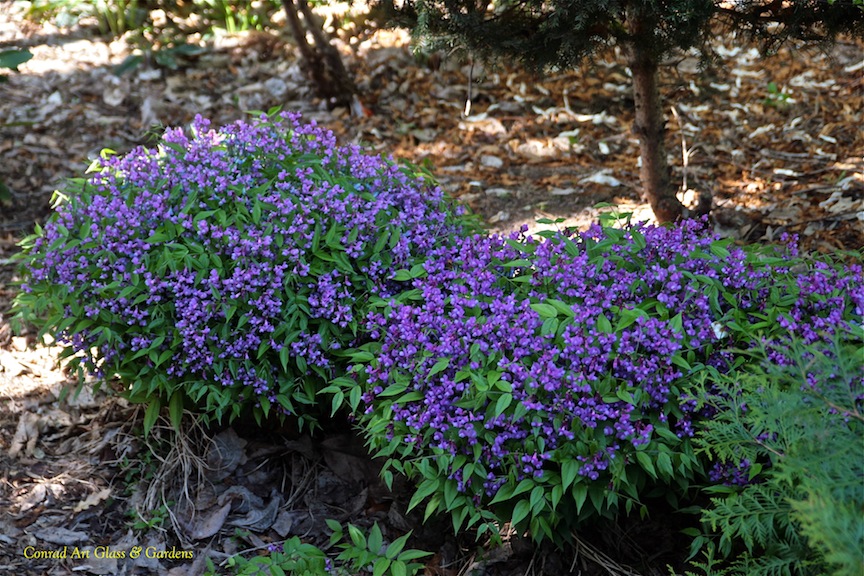
Lathyrus vernus
"Spring vetchling"
Hardy perennial of the pea family.
Clump former that is hardy to zone 3.
Native to Europe.
Difficult to divide...resents disturbance and grow a clump of roots like iron! 
Plant where you want it to grow.
Seeds about some, but you'll never hear me complain.
Blooms with my Magnolia soulangiana 'Brozzoni', but it's difficult to get it into new locations 
as I tend to forget to protect it from those rascally rabbits.
The darker plants seem to come in a variety of fine gradations of color but the pink ones are really special, and to my eye, more consistent in color.
Long bloom period, especially in cooler climates.
Easy, trouble-free other than being rabbit fodder, 
although they don't seem to bother my larger clumps
(YES)


Clematis recta 'Purpurea'
"ground clematis"
very hardy
The blooms are plentiful and attractive enough.
2'- 4' x 2'- 4'
A flopper that without support lays on the ground.
If cutting back is forgotten after the main bloom period there will be seedlings,
 copious in number... and as if that wasn't bad enough, they can be very difficult 
to extract from the soil or the crowns of other more worthy specimens, 
particularly if missed in their infancy.
Pictured immediately below to the left of the young fringe tree.
(NO)


See ya! Larry

Thứ Sáu, 2 tháng 11, 2012

A few of my garden favorites (and some I wish I'd never planted)... post #1


In considering what to post on through the winter, I've decided that it might be an interesting concept to feature plants from my gardens and to share my personal feelings and experiences with them. At the end of each profile I will feature a YES, MAYBE, OR NO in reference to whether this is a plant I am happy with or not (would plant again)... most will be Yes as I generally remove plants I'm not happy with... anyway, you get the point... so here goes...

 Picea pungens 'Moerheim' (above)
My personal favorite large blue spruce due to its exceptional color year round 
Some of this cultivar tend to be irregular growers
Smaller spruce to 40'
Plantings of Picea pungens cultivars should carefully considered as they are 
very diseased prone after about twenty-five years... 
there are other spruce varieties that have less disease concerns, 
such as Picea omorika and orientalis selections
(Yes!)
*****
Acer plantanoides 'Emerald Queen'
To 45' in width by 50' in height
What can I say... we were young and wanted a shade tree
I would never have planted a Norway Maple knowing what I know now...
Shallow roots/ crotches tend to split
Attractive flowers in spring but the samaras are a pain to deal with...
This is an invasive plant in many places!
(No!)


Cornus x Rutgers 'Stellar Pink'
to 25' or more
I expect this to be hardy here in colder parts of zone 5
New addition but I've seen good sized plants in bloom (bracts actually)... amazing sight!
(Yes! (so far))
*****
Carex hachijoensis 'Evergold'
An evergreen sweet flag out of Japan
My first attempt at growing sedges
I know it prefers average to moist soil/ love the mounded form  
If it does well here in zone 5, I'll be adding many as they really light up the garden!
(Yes! (so far))


Magnolia kobus va. loebneri 'White Rose'
This will eventually get quite large (15-20' ht and 12-15' in width)
Tiny buds open to small blooms that resemble gardenias or roses
zone 4 hardy and the fall color is excellent for a magnolia!
(Yes!) although it may get large for where I have it


Acer palmatum 'Osakazuki'
This a fairly fast growing Japanese maple renown for its fall color which is said to be the very best red of the Japanese maples... the problem is, mine gets hit by hard frost every year before it gets to its best color. It is still pretty however as can be seen by the photo below even if it doesn't make it all the way to 'really red'.
Zone 5 hardy with an ultimate size of 18' in colder climates 
Possible spread of 15' or more although considered an upright tree
Foliage color is a rich green all season until fall color begins
Color progresses through brownish brick reds to red and very red
I really like the look of this tree, including the summer foliage
(YES) 
(although I have restless nights out of concern over early 
spring frosts once the leaf buds have expanded and I'm always on the 
lookout for fungal diseases)
2nd photo is of my friends plant which colors better because 
100 miles south of here and is also a more mature tree)


Magnolia x 'Elizabeth'

Elizabeth is an excellent magnolia first hybridized in1956 
at the Brooklyn Botanic Garden by Evamaria Sperber.
I would personally rate it in my top five (along with about 20 other magnolias!!)
I personally feel that Elizabeth is zone 4 hardy despite what one generally reads.
I also have seen plants approaching 50' by up to 35' wide despite what some sources say.
Elizabeth is a fast grower, and I was pleased to see lots of bloom this 
year after the original round of blossoms froze.
Elizabeth has minmal disease concerns.
This year's fall color is pictured below as well as blossoming habit.
As I have repeated often on this blog, 
and directly from Dennis Ledvina (my magnolia hybridizing friend)... 
to be sure of hardiness, look for acuminata in a cultivar's background...
Elizabeth is Magnolia acuminata x M. denudata
(YES (YES and YES again!))


Malus 'Snowdrift'
Wow... talk about mixed emotions! This is a beloved plant in Spring and almost detested in mid-summer through fall...winter's ok.
Like so many other flowering crab apples, Snowdrift has problems with apple scab... now if you research dealing with this situation, you'll get all sorts of totally unrealistic in real life methods of dealing with the fungus. I should know... for years I sprayed twenty-five flowering crab apples and was successful in delaying the leaf drop two or three weeks. It was simply not worth 
the effort, the expense, or the risk.

When you've had a flowering crab for 35 years, it's difficult to let go... after all, the spring show is 'to die for' on Snowdrift and it has been developed with a form that I really appreciate. So I keep it... with some other flowering crabs, leaf drop occurred as early as mid-June... they are now gone, I guess you could say that Snowdrift has "some" resistance to scab unlike those others I've just referred to.

The main issues in limiting scab problems involve excellent air circulation and getting rid of the diseased fallen leaves where the spores live over winter... in some cases this isn't all that difficult while in other circumstances it's next to impossible. Finally, I decided twenty years ago that my health was more important than losing leaves on crab apples mid-summer, so I no longer spray.

Snowdrift has a spread of 20' and the height may be in that range as well. I've learned through experience that it is somewhat resistant to the dreadful Fire Blight that took many of my apple and crab trees years ago. With appropriate pruning practices, I was able to save Snowdrift after about two years of difficult maintenance.
(NO)


That's it for today! Larry

Labels

2012 lily/hemerocallis series 2012 magnolias and more Accessories afghan Amigurumi amirugumi Art Autumn 2012 baby crochet baby knitting Baby learn bag Bags Bead beeches Being thankful books booties bows boxes bracelet cake candy Cards carving carving fruit carving fruits Change in the garden Change in the gardens Christmas Letter clay clematis Closing down the gardens for winter coloring Conifer companions conifers conifers/hellebores Cornus x rutgersensis 'Galaxy' hybrid crafts crochet crochet pattern croci croci/hellebore/eranthus crocus cross stitch Crown of Thorns Curtain cutting paper daffodils Deciduous trees Delphiniums design/rhodies/tree peonies Developing the azalea walk 2012 diy Doll Dolls Door County Dragonflies in my studio... drawing dress Dusk Early August 2011 Early season gardens to 2013 Early spring Early spring gardens Early summer 2012 earring Easy dot Embroidery Embroidery - Thêu End of August 2011 epimediums Eranthis hyemalis etc. Fagus sylvatica 'Asplenifolia' Farewell to fall fashion Favorite garden views 2009 Favorite plant descriptions February in Wisconsin post #1 February in Wisconsin... post #2 February snow Felt First day of Winter 2011 first frosts First snow First snow... 11/10/11 Floral arrangements - Cắm và bó hoa flower arrangement Flowering crab apple page flowering crab apples flowers crochet fly over country Flying Pig foggy mornings Folding paper Folding towels food food decor Four seasons Funny garden Garden friends Garden guests Garden photos garden views Garden views 2010 garden views 2011 Garden views 2012 Gardens in review GBBD for JuneAmethyst Getting personal... Gifts Giving thanks Glass Shade gloves Green Bay Botanical Gardens Hair hair clip Hanging Lotus shade hat hats helebores Helebores and hepatica hellebore Hellebores Hemerocallis Hephestos tree peony Heptacodium Heptacodium miconioides Hoar frost holiday craft holiday crafts home and garden Hostas Hostas as landscape plants Houseplants how to Ice storm Individual plant portraits Iris Jan-May 2011 overview Japanese maples Japanese maples at Wavecrest Nursery jewelery jewelry jewerly Josephine clematis July 2011 review Khăn - Mũ kirigami knitting knitting pattern knot Labels... Late April 2013 Late autumn gardens Late blooming annuals Late July 2012 lawns Lewisia Lilac Lilacs lilacs 2013 Lilies and Hemerocallis macrame Magazine Magnolia 2013 Magnolia blooms Magnolia Daybreak Magnolia shade and transom Magnolia tripetala magnolias Maintaining a positive state of mind Maintaining gardening perspective making flower making flowers Making my own daylilies Making toys Memories from my youth mid-April 2012 walk-about mid-August 2012 Mid-December mid-June blooms Miniature orchids mittens Móc khăn trải bàn More cold mums nail Nail art necklace necklaces New azalea walk new glass projects Nghệ thuật No rain Northern Wisconsin November 1st color October color 2011 October garden pics Old trees Oleander One's Autumn Open gardens or Orchid case orchids orchids an walk in the woods orchids and hellebores Orchids and more Orienpet lilies 2011 oriental poppies Origami Pages painting Panels and Windows Panicum virgatum 'Shenandoah' Paper paper cut Patchwork Pella tulips peonies peonies in the studio and the gardens petunias 2011 Phalaenopsis orchids pillow Pillows Pining for Spring #2 Pining for Spring #3 Pining for Spring #4 Pining for Spring... Pinus dens 'Oculus Draconis' Plant moves and pruning plastic Play and learn for baby poncho Primula primula and hyper-tuffa Prom weekend Quercus coccinea Quilling paper Quilt Rain finally recycling repair work Request Return to October Rhododendrons Rhododendrons 2013 ribbon ring Rockery redo Rotary Gardens in Janesville rugs scarves Schlumbergera x buckleyi September blooms Several Examples of my work in stained glass lamp shades sewing sewing detail shawls shoes and sandals skirt skirts slippers Small wonders Snow scenes Snowstorm Draco socks Spring spring 2011 Spring 2012 spring 2013 Spring bloom spring bloom overlap Spring peak bloom Spring snow storm Stats still cold but there are plants that enjoy this... Still winter Sumac Summer 2011 summer peak 2011 sweater tablecloths tags Tatting Thalictrum rochebrunianum... Thanksgiving cactus The Christmas Gift The first real snowstorm of the winter (2011-2012) The fog is also a gift The gardener's life Thêu Thinking spring Thoughts from the files #1 Tiffany 24" Rosebush shade Touches of Autumn toys tree peonies Tree removal tulips Tutorial Tutorial video underwear Valentine's day Vermont in Autumn Video weaving wedding white gardens? White in the gardens Winter protection Winter scenes Winter/Summer comparisons wintering the non-hardys Wisconsin Wisconsin... Witch hazel/eranthus/ orchids/amarillis wool wrapping and packaging yarn