Hiển thị các bài đăng có nhãn Hostas. Hiển thị tất cả bài đăng

Thứ Ba, 1 tháng 2, 2011

My first hosta purchases (2)


This is part 2 of a post I started last time regarding hostas. If you recall, I was discussing some of the hostas that I purchased in 1986, many of which have yet to be divided. My first hosta was a gift from a friend's garden which I divided time and again over the years. Pictured above, I love this plant for special uses such as outlining this small annual bed (those by the way are camelot foxgloves). I can't recall the name just now, but this cultivar is extremely common and probably for good reason... it does well, even in a fair amount of sun. The picture below is basically the same view once the foxgloves started blooming...


Another of my earlier hosta purchases from 1986 was Gold Standard. This has been divided frequently in the past. It's pictured below at the front. I have found that since I stopped dividing my Gold Standards several years ago, I am getting numerous plants with reversions. Gold Standard is one of the most important new hostas of all time... it changed the hosta world. Beware of mass marketing of the plant these days, as virus X  has become a problem with this cultivar in some places. Watch for any uncharacteristic green blotches that appear on your newly purchased plant of Gold Standard. I would recommend buying hostas from a reputable source these days with the advent of virus X. It is also a good reason to be very careful when accepting gift hosta divisions from friends, if you intend to develop any sort of collection in the future... take a close look at the parent plant and compare it with what that cultivar should look like. There are examples of hostas being marketed as a new sport, when in fact they were affected by virus.


I'll quickly point out a few other of my 20-25 year old purchases. Below is a large Francis Williams which has never been divided... it is now having reversions, but I've decided to allow it to do its thing and remain undivided. It's pictured under the apple tree at the back of this photo. The reversions are a rather non-descript shade of gold...


There is one of my oldies that I'm removing reversions from because I absolutely love this hosta called Great Expectations. Everytime I see a well grown specimen of this, I am newly impressed. I have been using the reversions as they are a lovely blue.... I assume from the sieboldiana clan. The following photo shows Great Expectations with reversions in the spring before I remove them. The reversions are the blue leaves to the front of the photo...


Here are photos of Great Expectations early in the season, frequently divided to remove the reversions... these plants will expand considerably as the season goes on.


Another of my hostas purchased in the late 90's, whose texture is quite interesting is Inniswood, a sport of Sun Glow registered in 1993. This earned the Savory Shield award as best new hosta after being displayed at the AHS 1986 convention at Inniswood Botanical Garden in Ohio. The photo below shows it in a fair amount of sun which causes it to appear lighter than often pictured by other sources. This plant displays a good substance and holds well through the season.


Another really "good doer" that has been with me for many years is Sagae which was previously called Fluctuans Variegata. Sagae is from Japan and has been around for a long time. It is a large plant and will eventually reach a width of 70". It was the 2000 American Hosta Growers Association 'Hosta of the Year'. I can't recall ever seeing any slug damage on this plant in my gardens. There have been a number of registered sports from Sagae, including one of my newer favorites, Liberty, which I will show later in this post.


Another view of Sagae from two seasons ago is pictured below... it is the plant just above center in the photo... as you can see, it makes an impressive show...


I'll now change directions a bit and point out a few hosta cultivars that are either relatively new or in some cases newer to my gardens. I'll start with Liberty and then move to June, a Halcyon mutation registered in 1991 and the 2001 "Hosta of the Year". There is apparently confusion as to the "true" form of June. The plant is sometimes offered as June Type I or II and so on according to 'The Hostapedia'. Additionally the plant can look amazingly different depending on light conditions and age and month of the year. Never the less, it is one of the finest hostas available. 'The Hostapedia' relates that of  "well over 7200 cultivars, only 5% make any impact on landscaping and are a noteworthy source of seedlings and sports. June is on of those select cultivars."  Here are photos from my gardens of  Liberty, followed by June and related plants... I think the substance is one of the most attractive aspects of these hostas.

The previously mentioned Sagae sport called Liberty first introduced for sale in 2002


Hosta June 


June Fever is a sport of June made available in 2004, needs sun to retain bright center through the season


Touch of Class is a chemically induced sport of June from 1995 with double the leaf substance... a gorgeous plant


Remember Me, registered in 2001, is another June seedling named in remembrance of
Sandy DeBoer, an employee of Walters Gardens who died of breast cancer.
The spring color on this plant is amazing!


Just unfurling in spring, Dawn's Early Light will definitely light up your garden. First made available in 2001, it has excellent texture and pie crust edge. The color becomes calmer as the season progresses

Here's a  large grower introduced for sale in 2004 by Plant Delights Nursery.  Olga Petryszyn's introduction
called Brother Stefan has everything I like in a hosta


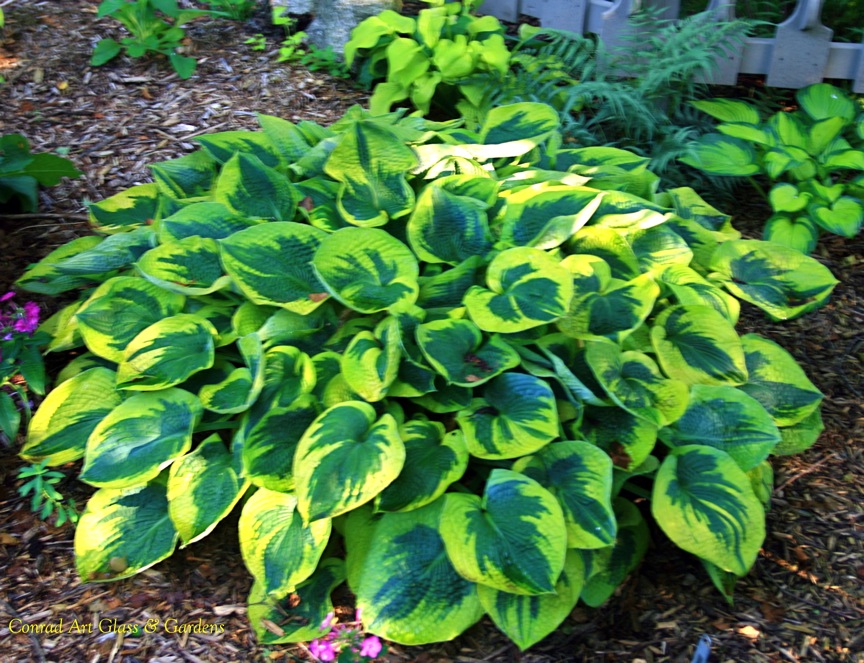
The 2006 Hosta of the Year is Stained Glass... this is a real winner in my opinion... love it!

I could go on showing individual cultivars for a very long time... there are many others that work well in my gardens. As I said earlier though, my main interest in hostas is how they look as part of the landscape. I'll close this post with photos showing just that.... some that I may have posted in the past, and a few new photos as well. 

I also want to refer again to 'The Hostapedia' which is the encyclopedia of hostas by Mark Zilis. It contains over 7400 descriptions of hostas with 1897 color photos. It is the definitive work on hostas and a must for collectors but very worthwhile for a gardener like myself. The only negative is that it's a huge book and weighs "a ton"! If you're not familiar with it and love hostas, you need to check it out! Take care, Larry


Thứ Hai, 31 tháng 1, 2011

My first hosta purchases (1)


In considering what to write about,  I came across the above photo from my spring gardens. It's been awhile since I've talked about hostas, so they are today's topic. I'm not certain how many different hosta cultivars are in the gardens... I suspect that the number is between 100 and 150 based on my incomplete records. Additionally, there are multiples of many of them. One rule that I've tried to stick by, is not to purchase different cultivars that look basically alike. As I visit the hosta gardens of serious collectors, I see remarkable numbers of cultivars that are kept to a couple divisions.. I much prefer the personality that comes as hostas mature into mother plants of seven or more years.The focal point in the bed pictured above is this very old specimen of Montana Aureomarginata originating from 1986 (pictured here in early spring), which really can't be beat for spring color. It was among my first hosta purchases. Prior to that I had only grown gifted hostas such as  the row of  variegated to the back in the above photo. In the late 1980's, I didn't have a lot of shade. I went through a short phase of buying hostas and didn't make other purchases  for years. About five years ago I got involved with a garden group among whom many members were hosta connoisseurs. I joined  NE Wisconsin's hosta society, The Green And Gold, and started purchasing a great many hostas. Since I like hostas that grow to very large sizes in particular, I realized last year that I'd best slow down in terms of adding many more to the gardens. So my phase two of hosta purchasing is pretty much past. Time will tell if there is to be a phase three! Today I will focus on a few of those original plants, now twenty-five years old without division for the most part.


A younger plant of Montana Aureomarginata contrasts nicely with the japanese anemones under the larger fern leaf beech in the photo below... the hellebore path can be seen beyond as it winds its way through the center of this bed.


I've also used Montana Aureomarginata in the front garden. It can be seen in this later season photo, just behind Bressingham Blue next to the fence... 


Yes, I would definitely consider Montana Aureomarginata a favorite and I like it best when the flame crab apple is in full bloom and seen below. This is early in the season, so this plant gains considerable stature as the season progresses, in fact, there will be no exposed soil once these hostas are fully expanded.


While the photo above is of the original and never divided plant, here's one final shot of another Montana Aureomarginata grouping showing that they work well with tulips.


There are a number of blues that I really like, but I'd have to say that I am most attached to this specimen of Blue Angel, first purchased in 1986  from Klehm Nurseries, which is now Song Sparrow Nursery in Avalon, Wisconsin... one of the finest mail order nurseries anywhere.


I get the impression from some of my hosta friends that having the very latest in hostas is a big deal. I can easily understand this mentality for many of them are in fact collectors, but for me it really doesn't work. I'm more interested in the overall concept of the landscape and "oldies but goodies" play into that very well. It would not be hard for me to choose my half dozen favorites... right at the top would be Tokudama Aureonebulosa. I have a great affinity for any hostas that have tokudama in them because of the cupped and heavily corrugated leaves. Aureonebulosa is a very slow grower... my plant was installed in 1986 and a few years later moved to its present location, but has never been divided... 


Another hosta installed in 1986 that is on my favorites list is Tokudama Flavocircinalis. This plant grows more rapidly than Aureonebulosa for me and I have divided them a few times. The larger specimen pictured below has had one division in twenty-five years. The leaves aren't quite as round as Aureonebulosa and the color is basically reversed, although I think Aureonebulosa is a little bluer... the following photo is slightly out of focus I'm afraid, but it's the only close-up of flavocircinalis that I have...


Flavocircinalis can be seen just in front and to the right of the birch in the following photo...


I find it difficult to take photos of individual hostas that really do justice, and I've observed from a variety of web sites that this can be a problem for others as well. Another 1986 purchase was Sum and Substance pictured below... as many of you will know, it really has to be seen to be fully appreciated...


In the following photo, Sum and Substance can be seen under the variegated maple. Just in front of it is another 20+ year old specimen called Mildred Seaver.  Aureonebulosa can be seen just to its front left. Mildred Seaver does a good job of picking up the colors of the maple at this early season time of year...


I will continue on this theme for the next few posts and expand into some of my newer hosta cultivars which I consider to have good potential. If you are a collector of hostas, you probably won't find anything cutting edge, but as I pointed out at the beginning, that's not my goal for my gardens.  Putting this post together today reminds me that I sometimes take my hostas for granted. It seems many folks either love or highly dislike hostas. In my experience, hostas could well be appreciated for what they do for the landscape more than they are, and should have an even greater appeal to a larger audience than they do. I guess my point is that hostas aren't just fillers in the gardens of the non-collector... they have a lot to offer when used appropriately and in combination with other shade loving plants.


We are anticipating up to 20" of snow in the next couple of days, although the storm's track isn't totally ascertained. I've been nurturing a slipped disk in my back for the past week with icing, heat, and chiropractic... I am doing better and hopefully will be well enough to use the snow blower if this report turns out to be accurate. Have a great day... as ever, Larry

Labels

2012 lily/hemerocallis series 2012 magnolias and more Accessories afghan Amigurumi amirugumi Art Autumn 2012 baby crochet baby knitting Baby learn bag Bags Bead beeches Being thankful books booties bows boxes bracelet cake candy Cards carving carving fruit carving fruits Change in the garden Change in the gardens Christmas Letter clay clematis Closing down the gardens for winter coloring Conifer companions conifers conifers/hellebores Cornus x rutgersensis 'Galaxy' hybrid crafts crochet crochet pattern croci croci/hellebore/eranthus crocus cross stitch Crown of Thorns Curtain cutting paper daffodils Deciduous trees Delphiniums design/rhodies/tree peonies Developing the azalea walk 2012 diy Doll Dolls Door County Dragonflies in my studio... drawing dress Dusk Early August 2011 Early season gardens to 2013 Early spring Early spring gardens Early summer 2012 earring Easy dot Embroidery Embroidery - Thêu End of August 2011 epimediums Eranthis hyemalis etc. Fagus sylvatica 'Asplenifolia' Farewell to fall fashion Favorite garden views 2009 Favorite plant descriptions February in Wisconsin post #1 February in Wisconsin... post #2 February snow Felt First day of Winter 2011 first frosts First snow First snow... 11/10/11 Floral arrangements - Cắm và bó hoa flower arrangement Flowering crab apple page flowering crab apples flowers crochet fly over country Flying Pig foggy mornings Folding paper Folding towels food food decor Four seasons Funny garden Garden friends Garden guests Garden photos garden views Garden views 2010 garden views 2011 Garden views 2012 Gardens in review GBBD for JuneAmethyst Getting personal... Gifts Giving thanks Glass Shade gloves Green Bay Botanical Gardens Hair hair clip Hanging Lotus shade hat hats helebores Helebores and hepatica hellebore Hellebores Hemerocallis Hephestos tree peony Heptacodium Heptacodium miconioides Hoar frost holiday craft holiday crafts home and garden Hostas Hostas as landscape plants Houseplants how to Ice storm Individual plant portraits Iris Jan-May 2011 overview Japanese maples Japanese maples at Wavecrest Nursery jewelery jewelry jewerly Josephine clematis July 2011 review Khăn - Mũ kirigami knitting knitting pattern knot Labels... Late April 2013 Late autumn gardens Late blooming annuals Late July 2012 lawns Lewisia Lilac Lilacs lilacs 2013 Lilies and Hemerocallis macrame Magazine Magnolia 2013 Magnolia blooms Magnolia Daybreak Magnolia shade and transom Magnolia tripetala magnolias Maintaining a positive state of mind Maintaining gardening perspective making flower making flowers Making my own daylilies Making toys Memories from my youth mid-April 2012 walk-about mid-August 2012 Mid-December mid-June blooms Miniature orchids mittens Móc khăn trải bàn More cold mums nail Nail art necklace necklaces New azalea walk new glass projects Nghệ thuật No rain Northern Wisconsin November 1st color October color 2011 October garden pics Old trees Oleander One's Autumn Open gardens or Orchid case orchids orchids an walk in the woods orchids and hellebores Orchids and more Orienpet lilies 2011 oriental poppies Origami Pages painting Panels and Windows Panicum virgatum 'Shenandoah' Paper paper cut Patchwork Pella tulips peonies peonies in the studio and the gardens petunias 2011 Phalaenopsis orchids pillow Pillows Pining for Spring #2 Pining for Spring #3 Pining for Spring #4 Pining for Spring... Pinus dens 'Oculus Draconis' Plant moves and pruning plastic Play and learn for baby poncho Primula primula and hyper-tuffa Prom weekend Quercus coccinea Quilling paper Quilt Rain finally recycling repair work Request Return to October Rhododendrons Rhododendrons 2013 ribbon ring Rockery redo Rotary Gardens in Janesville rugs scarves Schlumbergera x buckleyi September blooms Several Examples of my work in stained glass lamp shades sewing sewing detail shawls shoes and sandals skirt skirts slippers Small wonders Snow scenes Snowstorm Draco socks Spring spring 2011 Spring 2012 spring 2013 Spring bloom spring bloom overlap Spring peak bloom Spring snow storm Stats still cold but there are plants that enjoy this... Still winter Sumac Summer 2011 summer peak 2011 sweater tablecloths tags Tatting Thalictrum rochebrunianum... Thanksgiving cactus The Christmas Gift The first real snowstorm of the winter (2011-2012) The fog is also a gift The gardener's life Thêu Thinking spring Thoughts from the files #1 Tiffany 24" Rosebush shade Touches of Autumn toys tree peonies Tree removal tulips Tutorial Tutorial video underwear Valentine's day Vermont in Autumn Video weaving wedding white gardens? White in the gardens Winter protection Winter scenes Winter/Summer comparisons wintering the non-hardys Wisconsin Wisconsin... Witch hazel/eranthus/ orchids/amarillis wool wrapping and packaging yarn